View from the choir

I am a Catholic layperson and Secular Franciscan with a sense of humor. After years in the back pew watching, I have moved into the choir. It's nice to see faces instead of the backs of heads. But I still maintain God has a sense of humor - and that we are created in God's image.

Tuesday, June 15, 2010

St. Francis on "weeds"

"And they ought to rejoice when they converse with mean and despised persons, with the poor and the weak, with the infirm and lepers, and with those who beg in the streets." - From the Earlier Rule of St. Francis.

Thus "Brother Ass" calls for Franciscans to go among the "weeds" of the world.

Labels: ,

Monday, May 25, 2009

Another Franciscan Canticle

As part of our ongoing formation at my Secular Franciscan group, we have been studying the writings of St. Francis.

He is famous for his "Canticle of Brother Sun" - which we looked at last Friday.

But another Canticle we looked at was the "Canticle of Exhortation to Saint Clare and Her Sisters."

Listen, little poor ones called by the Lord,
who have come together from many parts and provinces.
Live always in truth,
that you may die in obedience.
Do not look at the life outside,
for that of the Spirit is better.
I beg you through great love,
to use with discretion the alms which the Lord gives you.
Those who are weighed down by sickness
and the others who are wearied because of them,
all of you: bear it in peace.
For you will sell this fatigue at a very high price
And each of you will be crowned queen
in heaven with the Virgin Mary.

There was much to think on and talk about in connection with this one, but one section struck me given my life in the last few years.

Those who are weighed down by sickness
and the others who are wearied because of them,
all of you: bear it in peace.

It is so easy to despair when you are sick.

It is also easy to grow weary when you care for people who are sick. It is easy to grow impatient, resentful, angry, frustrated, and just plain tired. I've had to deal with all of those feelings.

People who work with the families of the very ill are aware of this. There are so many wonderful respite programs available to help keep up one's spirits, to give one a break. I have not used such programs - yet - but I have found time alone, time in nature, time in prayer helpful.

It's interesting that St. Francis included this in his Exhortation. With what were the Sisters dealing? Possibly a number of members who were sick, maybe some who went too far in their fasting and penitence and who made themselves sick (imagine how easy it would be to get mad at those sisters with "self-inflicted" ills!).

And maybe he was thinking of his own infirmities and the effects they were having on others.

This reminds us that even saints must deal with many of the same problems us less-than-holy folks face.

It's easy to forget that while they are holy they never cease to be human.

Labels: ,

Sunday, May 10, 2009

Francis's Admonition 2: Self-Will

The second Admonition of St. Francis of Assisi focuses on "The Evil of Self-Will.

The Lord God said to Adam: "Of every tree of paradise thou shalt eat. But of the tree of knowledge of good and evil thou shalt not eat." Adam therefore might eat of every tree of paradise and so long as he did not offend against obedience he did not sin. For one eats of the tree of knowledge of good who appropriates to himself his own will and prides himself upon the goods which the Lord publishes and works in him and thus, through the suggestion of the devil and transgression of the commandment, he finds the apple of the knowledge of evil; wherefore, it behooves that he suffer punishment.

The last section is translated slightly differently in Francis and Clare: The Complete Writings.

"... what he eats become for him the fruit of the knowledge of evil. Therefore it is necessary that he bear the punishment."

As the name of this Admonition suggests, self-will is evil. In the Garden the fruit was not the source of evil. It was the decision to eat the fruit in disobedience that was evil. The sin was Adam and Eve's appropriating to themsleves the fruit they had been forbidden.

In my own life I so often stumble when I appropriate to myself something that, in and of itself is not evil, but in which I should not partake. Sin comes when I willfully choose to disobey, to follow my own path out of lust and greed and selfish desire.

Francis chose to follow the path of complete poverty. He chose to appropriate nothing to himself - luxury, sexuality, comfort, food, and so on, things that are of themselves not evil, but which can be the subjects of self-will. They were things that Francis believed he coveted out of his own desire, and not out of the will of God. God help me to follow Francis's lead and not follow the dictates of my own self-will, for that is when I am most likely to sin.

Labels:

Saturday, May 09, 2009

St. Francis - Admonition 1, and the Mass

St. Francis of Assisi did not write (or dictate) a great number of documents, letters, and so on that survive. In Francis and Clare: The Complete Works, his writings and sayings fill a scant 166 pages - and that includes editor's introductions and footnotes.

Among the writings he clearly considered important, and which he asked to be written exactly as he dictated them, were the Admonitions. The Admonitions - as the editors of Francis and Clare note, provide "Saint Francis's doctrine on the spiritual life."

The First Admonition - Of the Lord's Body - is the longest one. One translation reads:

The Lord Jesus said to His disciples: "I am the Way, and the Truth, and the Life. No man cometh to the Father, but by Me. If you had known Me you would, without doubt, have known My Father also: and from henceforth you shall know Him, and you have seen Him. Philip saith to Him: Lord, show us the Father, and it is enough for us. Jesus saith to him: Have I been so long a time with you and have you not known Me? Philip, he that seeth Me seeth [My] Father also. How sayest thou, Shew us the Father?" The Father "inhabiteth light inaccessible," and "God is a spirit," and "no man hath seen God at any time." Because God is a spirit, therefore it is only by the spirit He can be seen, for "it is the spirit that quickeneth; the flesh profiteth nothing." For neither is the Son, inasmuch as He is equal to the Father, seen by any one other than by the Father, other than by the Holy Ghost.

Wherefore, all those who saw the Lord Jesus Christ according to humanity and did not see and believe according to the Spirit and the Divinity, that He was the Son of God, were condemned. In like manner, all those who behold the Sacrament of the Body of Christ which is sanctified by the word of the Lord upon the altar by the hands of the priest in the form of bread and wine, and who do not see and believe according to the Spirit and Divinity that It is really the most holy Body and Blood of our Lord Jesus Christ, are condemned, He the Most High having declared it when He said, "This is My Body, and the Blood of the New Testament," and "he that eateth My Flesh and drinketh My Blood hath everlasting life." Wherefore [he who has] the Spirit of the Lord which dwells in His faithful, he it is who receives the most holy Body and Blood of the Lord: all others who do not have this same Spirit and who presume to receive Him, eat and drink judgment to themselves.

Wherefore, "O ye sons of men, how long will you be dull of heart?" Why will you not know the truth and "believe in the Son of God?" Behold daily He humbles Himself as when from His "royal throne" He came into the womb of the Virgin; daily He Himself comes to us with like humility; daily He descends from the bosom of His Father upon the altar in the hands of the priest. And as He appeared in true flesh to the Holy Apostles, so now He shows Himself to us in the sacred Bread; and as they by means of their fleshly eyes saw only His flesh, yet contemplating Him with their spiritual eyes, believed Him to be God, so we, seeing bread and wine with bodily eyes, see and firmly believe it to be His most holy Body and true and living Blood. And in this way our Lord is ever with His faithful, as He Himself says: "Behold I am with you all days, even to the consummation of the world."

As I reread this one, I was reminded of something I heard on a radio show. One person observed that while we talk about the departed Saints who are with Jesus, perhaps with a bit of longing to experience what the Saints are experiencing, we actually are already with Jesus on a regular basis. Every time we are at Mass, every time we receive Communion, we are with Jesus just as fully as the Saints.

Imagine if we acted at Mass exactly as we would act if we were in the presence of Jesus. But then, we are in the presence of Jesus!

Imagine if we focused on that celebration exactly as we would focus on Jesus were He before us. But then, He is before us, in Flesh and Blood, on the altar!

He is with us, as Saint Francis says, "in this way our Lord is ever with his faithful.

Wherefore, all those who saw the Lord Jesus Christ according to humanity and did not see and believe according to the Spirit and the Divinity, that He was the Son of God, were condemned. In like manner, all those who behold the Sacrament of the Body of Christ which is sanctified by the word of the Lord upon the altar by the hands of the priest in the form of bread and wine, and who do not see and believe according to the Spirit and Divinity that It is really the most holy Body and Blood of our Lord Jesus Christ, are condemned, He the Most High having declared it when He said, "This is My Body, and the Blood of the New Testament," and "he that eateth My Flesh and drinketh My Blood hath everlasting life."

... And as He appeared in true flesh to the Holy Apostles, so now He shows Himself to us in the sacred Bread; and as they by means of their fleshly eyes saw only His flesh, yet contemplating Him with their spiritual eyes, believed Him to be God, so we, seeing bread and wine with bodily eyes, see and firmly believe it to be His most holy Body and true and living Blood. And in this way our Lord is ever with His faithful, as He Himself says: "Behold I am with you all days, even to the consummation of the world."

Labels: , ,

Sunday, March 01, 2009

St. Francis - Admonition 11

At our Secular Franciscan meeting Friday, we talked about the Admonitions of St. Francis.

We are reading the versions in Francis and Clare: The Complete Works. Someone brought in the The Omnibus of Sources, and that has a slightly different translation, and I went online and found still more.

The points remain the same, but some of the translations make them clearer.

Part of our discussion was which of the Admonitions struck us individually. I could have cited several, but Number 11 hit home. (Below is an online version.)

11. That one must not be seduced by Bad Example.

To the servant of God nothing should be displeasing save sin. And no matter in what way any one may sin, if the servant of God is troubled or angered—except this be through charity—he treasures up guilt to himself. The servant of God who does not trouble himself or get angry about anything lives uprightly and without sin. And blessed is he who keeps nothing for himself, rendering "to Cæsar the things that are Cæsar's and to God the things that are God's."

The point that struck me was about being troubled and angered over the sin of another except through charity. Such noncharitable anger "treasures up guilt" ("drawing blame" according to the Omnibus, and "stores up guilt" according to Francis and Clare.)

I am prone to that failing. (I am prone to failure in connection with many of the Admonitions!) I grow too easily angry at perceived faults in others, sometimes missing the even greater faults in me.

Marty (group leader) recommended that instead of reading further in the book, we use the Admonitions for meditations during Lent. I have much to meditate over.

Labels: ,

Saturday, September 06, 2008

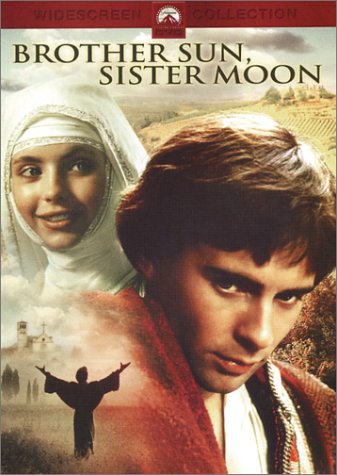
Brother Sun, Sister Moon

Wanting to get away from hurricanes and politics, the Good-Looking-One and I decided to watch a movie last night. I had recently found a copy of Brother Sun, Sister Moon at the local Catholic shop - a movie I had not seen in years, and which she had never seen.

Ah yes, the hippie saint - at least as he appears in this 1973 Franco Zeffirelli film. (He had previously done Romeo and Juliet, and would later do Jesus of Nazareth; you'll see some familiar faces and techniques in this film if you've seen those two movies.)

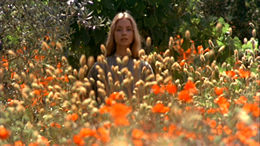
But there were some "hippie" aspects to St. Francis - the innocence, the idealism, the joy, the love of nature - and this film captures that. The cinematography is beautiful (typical of Zeffirelli), and as it was filmed near Assisi you get a sense of some of the beautiful landscape - all those flowers! - Francis would have seen.


Sure, the movie is incomplete. It only focuses on the early days, leaving out the illnesses, the failures, the struggles in the order, the stigmata. It only goes up to the point when Francis and his followers go to Rome to meet with Pope Innocent III (played by Alec Guinness).
One could also argue, however, that The Passion of the Christ only focused on one horrific but magnificent period in Jesus' life. The purpose of the film - as was true of Passion - was to focus on one part of the story, not the whole story.

Brother Sun also takes some liberties with the facts - as do most such biopics. (I've heard that 1989's Francesco is fairly accurate, but I haven't seen that one yet.)

As seemingly "light" as it is, BSSM does allude to deeper issues: The bloated, materialistic parts of the Church that Francis would help to reform, the dangers of trying to live the Gospel message (with the church Francis and his followers were rebuilding being attacked and one of his followers being killed), the love of material wealth built by exploiting and abusing workers, the neglect of the poor.

But the point of the movie was capturing the spirit of Francis, "The Joyful Beggar."

It succeeded. If you haven't seen it, I recommend it. It might especially appeal to teens (if they haven't been too jaded by television and so-called "realistic" teen fare).

Labels:

Monday, September 01, 2008

St. Francis and light


Francis embraced all things with an unheard of love and devotion, speaking to them of the Lord and exhorting them to praise Him. He spared lights, lamps, and candles, refusing to be responsible for extinguishing their light which he saw as a symbol of the eternal Light.
- from Celano's second life of St. Francis.

Labels: